 how-to
Can Martial Arts Improve Listening Skills for Kids?
Last Updated: November 4, 2026
Quick Summary
Martial arts can improve listening skills in kids by turning listening into a physical habit: students hear a command, watch a demonstration, then repeat it with their body. This loop builds attention faster than verbal practice alone, and classes teach kids to watch the instructor, wait for the signal, and respond.
- Keep listening game sessions short: five to ten minutes beats a long session every time.
- Get to eye level, use their name first, and say one thing at a time.
- Build direction-following as a skill ladder, starting with one-step directions with a visual cue.
- A three-year-old who follows one simple direction, often with a gesture, is on track.
- Start with your pediatrician, who can screen for hearing issues, a common cause of listening problems.
Table of Contents
- Why Listening Skills Matter More Than Ever for Kids
- Listening Games for Kids That Build Focus Without Boredom
- How to Get Kids to Listen Without Yelling
- Following Directions Activities for Kids: A Step-by-Step Plan
- Listening Skills for Preschoolers: What's Normal at Ages 3 to 5
- How Martial Arts Training Reinforces Listening at Every Age
- When Listening Struggles Need More Than Practice
- Book a Free Class and Watch Your Child's Focus Grow
- Frequently Asked Questions
Why Listening Skills Matter More Than Ever for Kids
Listening is the foundation skill behind almost everything else a child learns.
Why does it matter so much now? Screens compete for attention from an early age. Classrooms ask kids to process multi-step instructions. Playgrounds reward kids who can read social cues. A child who struggles to listen is not being defiant.
Here is the good news. Listening is trainable. It improves with practice, patience, and the right kind of structure.
Listening Games for Kids That Build Focus Without Boredom
Games work because kids practice listening without realizing they are practicing. A common mistake is turning practice into a drill. Kids shut down fast when it feels like homework.
Try games that add a physical or silly element. Movement keeps attention high. Laughter lowers the pressure. The American Academy of Pediatrics guidance on play and child development notes that play is one of the main ways children build attention and self-regulation.
Three Games You Can Start Tonight
- Simon Says with a twist. Add two-step commands ("touch your nose, then spin once"). Two-step directions build working memory.
- Sound detective. Close eyes for 30 seconds and name every sound heard. This trains focused listening.
- Story freeze. Read a short story and have your child freeze whenever they hear a chosen word. Simple, fast, and repeatable.
Keep sessions short. Five to ten minutes beats a long session every time. Stop while it is still fun.
How to Get Kids to Listen Without Yelling
Yelling works in the moment and fails over time. It teaches kids to tune out until volume rises.
The core shift is this: get close, get low, and get their eyes before you speak. A direction shouted from another room is easy to ignore. A direction delivered face to face is not.
- Get to eye level and use their name first.
- Say one thing at a time, in plain words.
- Ask them to repeat it back.
- Praise the follow-through, not just the obedience.
For a deeper set of at-home focus strategies, see how you can improve your child's focus at home.
What to Say in the Moment
Specific language beats vague commands. Swap "be good" for "walk, don't run." Swap "listen to me" for "put the blocks in the bin, then come sit."
Try this script:
"Leo, look at me. One job: shoes by the door. Tell me the job. Great. Go."
Then wait. Silence gives a child room to process. If nothing happens, repeat once, calmly, and offer a choice: "Do you want to do it now, or in one minute?"
Following Directions Activities for Kids: A Step-by-Step Plan
Building direction-following is a skill ladder. Start where your child succeeds, then climb one rung at a time. This plan works for most ages with small adjustments.
- One-step directions with a visual cue. "Hand me the red cup." Point first, then fade the point.
- One-step directions without a cue. Same task, no pointing.
- Two-step directions. "Get your coat and stand by the door."
- Directions with a delay. Give the task, then wait ten seconds before they start.
- Directions in a busier setting. Practice at the store or playground.
- Directions from another adult. Grandparents, coaches, teachers. This is the real-world test.
| Step | Skill Focus | Typical Duration | Sign It's Working |
|---|---|---|---|
| 1 | One step with cue | 1-2 weeks | Completes without reminders |
| 2 | One step, no cue | 1-2 weeks | Responds to name plus task |
| 3 | Two-step directions | 2-3 weeks | Holds both steps in mind |
| 4 | Delayed start | 2 weeks | Waits before acting |
| 5 | Busy settings | 3-4 weeks | Stays on task with noise |
| 6 | Other adults | Ongoing | Follows coach or teacher |
Watch out: skipping rungs is the most common reason this plan stalls. A child who fails step three usually needs more time at step two, not more pressure.
Listening Skills for Preschoolers: What's Normal at Ages 3 to 5
Preschool listening looks different from school-age listening. A three-year-old who follows a single direction is on track. A five-year-old who can handle two steps in sequence is right where they should be. The mistake many parents make is expecting school-age listening from a preschooler, then reading normal development as defiance.
Here is a more concrete guide, with what to try at each stage:
- Age 3: follows one simple direction, often needs a gesture or a point. Try: "Put the bear in the basket." Pair the words with a point, then fade the point over a week or two. A three-year-old who needs the gesture is not behind.
- Age 4: follows two related steps, may need one reminder. Try: "Wash your hands, then come to the table." If the child does the first step and stalls, repeat only the second step rather than the whole direction.
- Age 5: follows two to three steps and can repeat instructions back. Try: "Get your shoes, put them by the door, and bring me your backpack." Asking "What are the three things?" before they start builds working memory.
Preschoolers also need shorter windows. Attention spans grow steadily through these years. Expecting a four-year-old to hold focus for fifteen minutes on a chore sets everyone up to fail.
Sample scripts for preschool listening
Specific language beats vague commands at every age, but it matters most with preschoolers, who are still building vocabulary for sequences.
- Instead of "clean up," try: "Blocks in the bin, books on the shelf. Show me the blocks first."
- Instead of "be careful," try: "Walk your feet, hands by your sides."
- Instead of "listen," try: "Eyes on me, then I'll give you one job."
When a preschooler hesitates, narrate the choice rather than repeating the command: "You can put the red cup in the sink or hand it to me. Which one?" This keeps the direction intact while giving the child a sense of control.
Watch out: adding more words when a preschooler doesn't respond is the most common trap. A long explanation sounds like background noise to a three-year-old. Shorten the direction instead of repeating it louder.
When preschool listening is worth a closer look
Most preschool listening quirks are developmental. A few patterns are worth raising with a pediatrician:
- The child does not respond to their name consistently by 12 months, or does not follow simple directions by 18 to 24 months.
- Directions are missed in every setting, not just new or noisy ones.
- The child seems to hear some sounds but not others, or turns one ear toward the speaker.
- Teachers or caregivers raise the same concern more than once.
The Centers for Disease Control and Prevention developmental milestones checklists by age are a useful conversation starter. Bring specific examples of what you see at home rather than a general worry; pediatricians can act on patterns, not impressions.
How Martial Arts Training Reinforces Listening at Every Age
Martial arts turns listening into a physical habit. Students hear a command, watch a demonstration, then repeat it with their body. That loop builds attention faster than verbal practice alone.
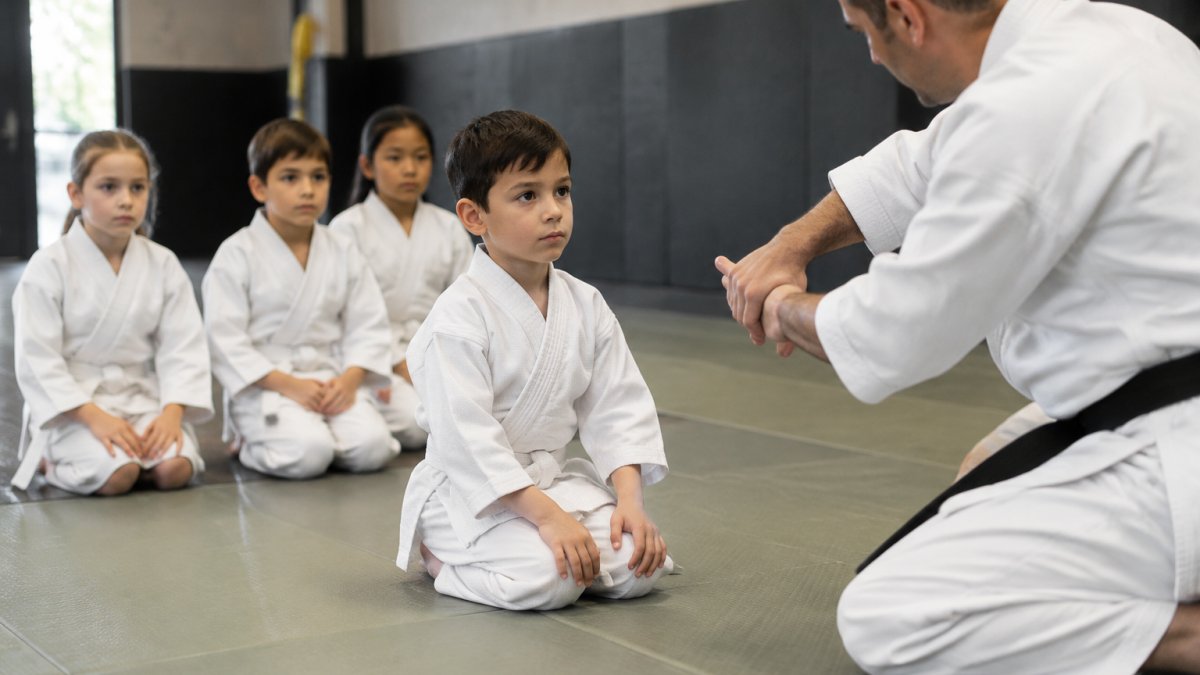
Martial arts classes can help kids learn to watch the instructor, wait for the signal, and respond.
For a fuller explanation of the connection, read how to improve child focus with martial arts. The benefits carry across ages, from preschoolers learning to wait their turn to older kids handling multi-step drills.
When Listening Struggles Need More Than Practice
Some listening struggles are temperament. Others need outside support. Knowing the difference saves months of frustration, and it is the question most parents ask but few articles answer directly.
Temperament shows up as a slow-to-warm-up style. The child listens fine at home but needs time in new places, or follows directions well with a familiar adult and freezes with a coach or teacher.
Clinical concern looks different. Key markers to discuss with a professional include persistence, pervasiveness, and distress:
- Difficulty following directions in every environment, not just new or noisy ones.
- Frequent confusion about what was said, or repeated "what?" even in quiet rooms.
- Frustration or meltdowns tied specifically to not understanding, happening most days for six weeks or more.
- Avoidance that shrinks the child's world, such as refusing birthday parties, school drop-off, or activities they used to enjoy.
- Teachers raising the same concern repeatedly across a semester, not once after a hard week.
- Physical signs during listening demands, such as stomachaches, headaches, or clinging that appears only before group activities.
A useful distinction: temperament-driven hesitation eases within minutes to an hour once the child settles in, and recovery time shortens with repeated exposure.
What to do next
Start with your pediatrician. Bring three things: a written log of when the struggle happens, how long recovery takes, and what settings are affected; any teacher or caregiver observations; and your child's developmental history.
The Centers for Disease Control and Prevention developmental milestones checklists by age are a useful conversation starter, not a diagnosis. For hearing specifically, the American Speech-Language-Hearing Association publishes plain-language guidance on what to expect at each age.
Watch out: waiting for a child to "outgrow" a listening problem that affects every setting is the most common reason support arrives later than it could.
If you are weighing whether martial arts fits your child, our parent's guide to whether martial arts is good for kids covers what to expect.
Book a Free Class and Watch Your Child's Focus Grow
Listening is a skill, and skills grow with practice in the right setting. If you want a structured, encouraging place for your child to build focus and confidence, start with a trial. Our guide to booking a free trial class walks you through what to expect, and you can explore our kids and adult classes to find the right fit.
Goshinkan Jujitsu Dojo offers classes for all ages and skill levels, with a focus on discipline, perseverance, and self-confidence. Get started with Goshinkan Jujitsu Dojo and watch your child's listening skills grow on and off the mat.
Frequently Asked Questions
How can I improve my child's listening skills at home?
Start with short, low-pressure routines. Give one instruction at a time, make eye contact, and ask your child to repeat it back. Add listening games for kids, like Simon Says or sound scavenger hunts, two or three times a week. Praise the behavior you want to see, such as 'You put your shoes away the first time I asked.' Consistent practice in small doses works better than long lectures about paying attention.
How do I get my child to listen without yelling?
Get close, get low, and get their attention before you speak. Say their name, wait for eye contact, then give one clear direction in a calm voice. Yelling teaches kids to tune out until the volume rises. If you feel frustration building, pause and try again in a minute. Children follow directions more reliably when instructions are short and followed by a specific, genuine compliment.
Do martial arts classes actually help kids listen better?
Martial arts training asks children to watch, listen, and respond to instructions in a structured setting, which builds focus and self-control over time. Students practice following directions, taking turns, and staying calm under mild pressure.
When should I be concerned about a child's listening difficulties?
Occasional forgetfulness is normal, especially for preschoolers. Talk with your pediatrician if your child consistently cannot follow two-step directions by around age four, seems not to hear you, struggles in quiet settings too, or shows ongoing distress at school or with peers. A hearing check and a professional evaluation can rule out issues that practice alone will not fix.
The challenge is simple: listening improves through practice, not pressure. Goshinkan Jujitsu Dojo gives kids a structured, welcoming place to build that skill week after week. With expert instructors, small-group attention, and a focus on discipline and confidence, we make practice feel like play. Get started with Goshinkan Jujitsu Dojo and give your child a space where focus grows naturally.