 how-to
How Can You Improve Your Child's Focus at Home?
Last Updated: October 30, 2026
Quick Summary
You can improve child focus at home by building a predictable daily routine, matching short work periods to your child's real attention span, and creating a quiet, tidy workspace with screens out of reach. Give one task at a time, break it into small steps, and build movement and active play into the day.
- A child can focus for roughly two to five minutes per year of age on an interesting task.
- Set a visible timer and have your child stop when it rings, even if the work is unfinished.
- Get eye contact, say a direction once in one short sentence, then ask your child to repeat it back.
- School-age kids generally need 9 to 12 hours of sleep a night, and teens 8 to 10.
- Change only one variable, such as sleep or screens, for two weeks before judging the result.
Table of Contents
- What Realistically Changes Child Focus at Home
- Child Attention Span by Age: What to Expect Before You Push
- How to Help Kids Focus on Homework Without a Fight
- How to Teach Kids to Follow Directions the First Time
- Activities to Improve Concentration in Kids (Beyond Screens)
- A Sample Home Focus Routine You Can Start This Week
- When Focus Strategies Aren't Working: What to Check Next
- Book a Free Class and Watch Focus Grow
- Frequently Asked Questions
What Realistically Changes Child Focus at Home
Most parents who search for how to improve child focus at home are looking for the same thing: fewer battles over homework and a kid who can sit still for more than five minutes. Structured, consistent practice is one of the most reliable ways children build the ability to hold attention on a single task.
Focus is a skill, not a personality trait. It builds through repetition, clear expectations, and an environment that removes easy distractions. No single trick fixes it overnight.
What actually moves the needle is boring and reliable:
- A predictable daily routine your child can count on
- Short work periods matched to their real attention span
- A quiet, tidy workspace with screens out of reach
The strategies below work together. Skip the routine and the timer alone will not save you. For a concrete option beyond home tweaks, read how to improve child focus with martial arts.
Child Attention Span by Age: What to Expect Before You Push
Attention span grows with age, and expecting too much too soon is the most common mistake we see. The American Academy of Pediatrics guidance on developmental milestones reminds parents that children develop at different rates, so treat any benchmark as a rough guide, not a test.
Rough Attention Benchmarks by Age
A common rule of thumb many educators use: a child can focus for roughly two to five minutes per year of age on a task they find interesting. That means a four-year-old might manage 10 to 15 minutes, while a ten-year-old can often handle 25 to 40 minutes. Boring tasks shrink those windows fast.
Matching Task Length to Your Child's Window
Watch your child, not the clock on the wall. If they lose focus at 12 minutes, set the timer for 10. Ending on a win beats pushing to frustration. Then stretch the window slowly over weeks.
How to Help Kids Focus on Homework Without a Fight
The fight usually starts before the homework does. Kids resist because the task feels huge, the space is chaotic, or they are already drained. Fix those three things and most of the battle disappears, but the fix looks different depending on how old your child is and where the resistance actually comes from.
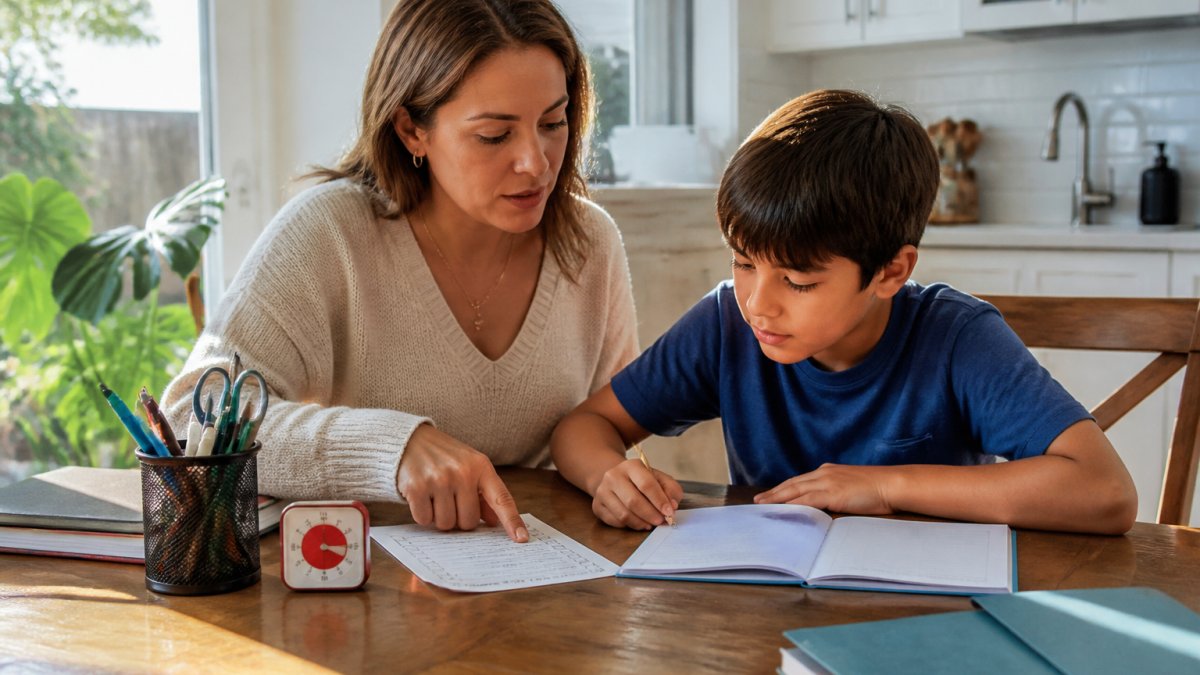
Set Up the Space and the Timer
Clear the table except for what the assignment needs. Put phones and tablets in another room, not just face down on the desk, where a buzz still pulls attention.
Break the Assignment Into Small Steps
"Finish your worksheet" is overwhelming. "Do the first three problems" is doable. Write each step on a sticky note and let your child crumple it when finished. That small ritual gives a real sense of progress, and progress is what keeps a child coming back to the next block.
A simple pattern works well:
- Write down every step of the assignment.
- Number them in order.
- Do one step per timer block.
- Take a short break between blocks.
- Check off each step together.
Help Them Start, Not Just Continue
Most homework resistance is a starting problem, not a focusing problem. A child who cannot begin will never get to the part where focus matters. Three concrete ways to lower the start cost:
- The two-minute rule. Tell your child they only have to work for two minutes. Starting is the hard part; once they are in, most kids keep going. If they genuinely stop at two minutes, that is data, not defiance.
- Start with the easiest item. Beginning with a win builds momentum. Save the hardest subject for the second or third block, when the routine is already running.
- Do the first step together. Read the first question aloud, sharpen the pencil, open to the right page. Removing the setup friction is often enough to get them moving.
Match the Approach to Your Child's Age
- Preschoolers (ages 3-5): Formal homework is rare at this age, but "table time" practice, a puzzle, a sorting game, a short coloring task, builds the same muscle. Keep blocks to 5-10 minutes and sit nearby.
- Early elementary (ages 6-8): Expect 10-15 minute blocks with a break between each. Directions should be one sentence. A visual checklist (pictures work) beats a verbal list.
- Upper elementary (ages 9-11): 15-20 minute blocks. Kids this age can start to plan their own order of tasks, which builds ownership. Let them choose which subject comes first.
Troubleshoot the Three Most Common Breakdowns
- "I don't know how to do it." This is a task-difficulty problem, not a focus problem. Sit down, work the first problem together, then step back. If the confusion is subject-wide, that is a conversation for the teacher, not a timer adjustment.
- "I'm too tired." Check the schedule before you check the child. Homework immediately after school often fails because blood sugar and energy are at their lowest. A snack and 20 minutes of movement first frequently fixes what no amount of encouragement can.
- "I keep getting up." Reduce the escape routes: water bottle at the table, bathroom trip before the block starts, pencil sharpened. Each small removal of a legitimate excuse makes the timer block easier to hold.
How to Teach Kids to Follow Directions the First Time
Getting a child to follow directions starts with giving better directions. Most instructions fail because they are too long, given from another room, or buried in a stream of words.
Try this sequence:
- Get eye contact before you speak.
- Say it once, in one short sentence.
- Ask them to repeat it back.
A common mistake is repeating yourself three times, which teaches a child that the first request does not count. Say it once, calmly, and hold the expectation.
Activities to Improve Concentration in Kids (Beyond Screens)
The best activities to improve concentration in kids are often the ones that look like play. Focus training does not need a workbook. It needs movement, practice, and a little structure.
Movement, Active Play, and Calmer Activities
Physical activity primes the brain for attention. A run around the yard before homework often does more than a lecture about sitting still. Pair that with calmer activities that require patience: puzzles, building sets, card games, or simple mindfulness breathing for a minute or two.
For families trying to cut screen time, our guide on how to get kids off screens lays out a step-by-step plan you can follow at home.
A Sample Home Focus Routine You Can Start This Week
Consistency beats intensity. Here is a routine you can run for one week and adjust as you learn your child's rhythm.
| Time | Activity | Purpose |
|---|---|---|
| After school | Snack and 20 minutes of active play | Reset energy |
| 4:00 pm | Clear the workspace, screens away | Remove distractions |
| 4:10 pm | Homework block one, timer set | Short focus period |
| 4:25 pm | Short break, movement or water | Refocus |
| 4:35 pm | Homework block two | Task completion |
| Evening | Same bedtime every night | Protect sleep |
Keep the order the same each day. Kids relax when they know what comes next. Our practical guide to building focus through martial arts goes deeper on routines that stretch attention over time.
When Focus Strategies Aren't Working: What to Check Next
If weeks of routine and timers change nothing, stop pushing harder and start looking at the basics. Persistent focus trouble usually has a cause underneath it, and the cause determines which strategy will actually help. Work through the checks below in order, most families find the answer in the first two.
Step 1: Rule Out the Physical Basics
Check the simple things first, because they are the most common and the easiest to fix:
- Sleep. Is your child getting enough sleep on a consistent schedule? School-age kids generally need 9-12 hours a night, and teens 8-10 (Sleep in Middle and High School Students | Healthy Schools). A child who is short an hour a night will look distractible long before they look sleepy.
- Food and water. Are they eating breakfast and drinking water through the day? Blood sugar swings and mild dehydration both show up as poor attention, especially mid-morning and mid-afternoon.
- Movement. Do they get real physical activity, not just recess? Twenty minutes of active play before a focus period often does more than any lecture about sitting still.
Many families find that fixing sleep alone changes the picture within a week or two. Give any change at least two weeks before judging it.
Step 2: Identify Which Kind of Focus Problem You're Seeing
Not all focus trouble is the same, and the right response depends on the pattern:
- Environmental distraction. Your child focuses fine in a quiet room but falls apart in a busy one. Response: change the environment, not the child.
- Fatigue. Focus is good early in the day and collapses later. Response: move demanding tasks earlier and protect sleep.
- Stress or worry. Focus drops during transitions, tests, or family changes. Response: address the worry directly; a timer will not fix anxiety.
Step 3: Try a Two-Week Troubleshooting Plan
Before assuming something is wrong, run a deliberate experiment:
- Pick one variable, sleep, screens, or movement, and change only that for two weeks.
- Keep the rest of the routine steady so you can tell what made the difference.
- Track what you see in a simple note: better, worse, or same, in the morning and after school.
- If nothing changes, move to the next variable.
This is not about finding a single culprit. It is about gathering enough information to know whether the problem is environmental, health-related, or something that needs outside evaluation.
When to Talk to a Professional
If focus problems persist across school, home, and activities after you have addressed sleep, food, movement, and screens, talk to your pediatrician. The Centers for Disease Control and Prevention information on ADHD diagnosis explains what an evaluation involves. A doctor can rule out hearing, vision, or sleep issues and point you to the right support. This article is general guidance, not a diagnosis.
For parents weighing structured outside help, our parent's guide on whether martial arts is good for kids covers what a good program should offer.
Book a Free Class and Watch Focus Grow
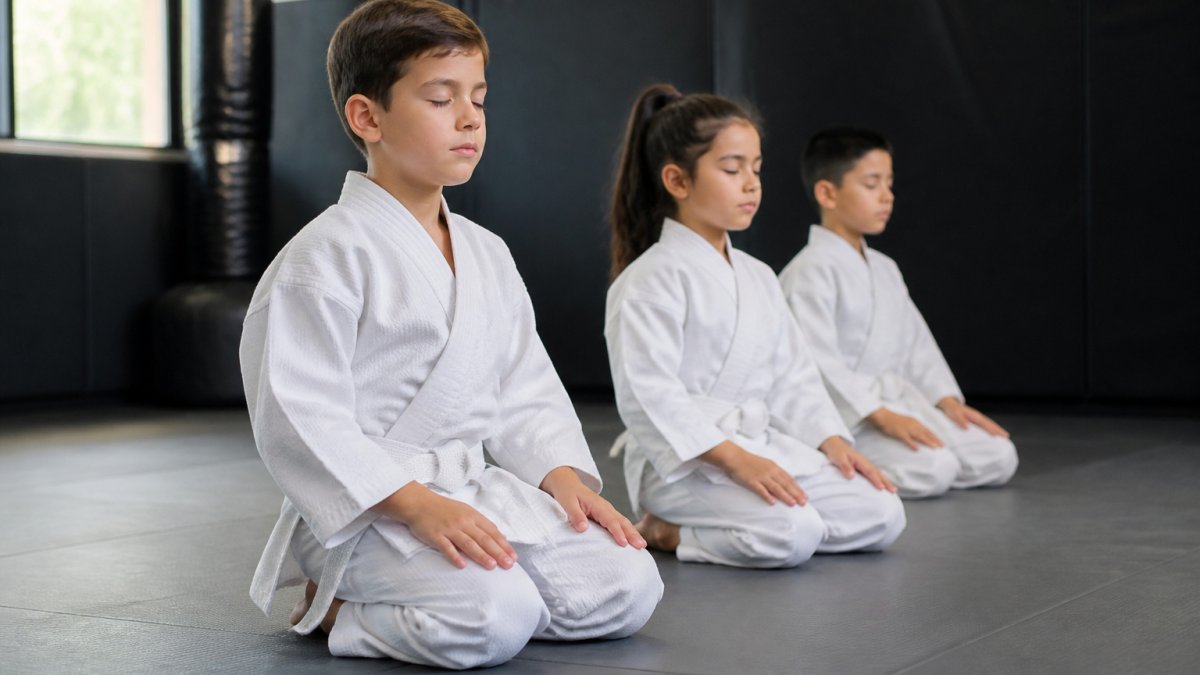
Focus grows fastest when a child practices it somewhere they enjoy. Goshinkan Jujitsu Dojo offers a structured, encouraging space where kids can build discipline and self-confidence.
Ready to see it? Read our complete guide to booking a trial class and find out what to expect on your first visit. Get started with Goshinkan Jujitsu Dojo and watch your child's focus grow.
Frequently Asked Questions
What causes lack of focus in kids?
Most focus trouble at home comes from everyday conditions rather than a disorder. Common causes include too little sleep, hunger or dehydration, a noisy or cluttered workspace, screens within reach, and tasks that are simply too long for the child's age. Children also lose focus when instructions are vague or given all at once. Before assuming a bigger issue, check the basics: a consistent bedtime, a quiet space, short directions, and homework broken into small steps. If focus problems persist across school and home for months, talk to your pediatrician.
How long should a child focus on homework at a time?
Match the session to your child's realistic attention window, not to the size of the assignment. Younger children often do best with 10 to 15 minutes of work followed by a short break; older elementary kids can usually handle 20 to 25 minutes. Use a visible timer so the end is predictable, then take a 3 to 5 minute break with movement or water. Two or three short blocks with breaks usually finish homework faster than one long, frustrated sitting. If your child needs more time, add blocks rather than lengthening each one.
What activities help improve a child's focus and concentration?
Choose activities that require sustained attention and clear rules. Puzzles, building sets, card games, drawing from a model, and memory games all practice focus training in a low-pressure way. Active play matters too: movement and outdoor time help kids return to calmer activity with better attention. Keep sessions short and consistent; ten focused minutes a day builds more concentration skills than an occasional long project.
When should I talk to a professional about my child's attention?
Talk to your pediatrician if focus difficulties show up in more than one setting, such as home and school, and last for several months. Other signals include trouble following simple directions, frequent lost items, difficulty starting tasks, and problems that affect learning or friendships. Bring notes on sleep, routines, and what you have already tried at home so the conversation is specific. A professional can rule out sleep, vision, or hearing issues and advise on next steps. Early guidance is more useful than waiting for a hard year.